Meditations on Sexual Chinoiserie
These articles by Sheena Rheed originally appeared in seriem on EroticaSinica.com on May 30th, 2024 and October 24th, 2024 respectively. The following is a monolingual English compilation of those serials.
At this point, it is high time to acknowledge the proverbial elephant in the room. Several clients who came to see me have, by now, already remarked upon the overt themes of Asiatic culture and identity that infuse this entire platform. Suffice to say, it should come as zero surprise to my audience that, in terms of ethnic heritage, I am not even remotely Asian by any standard of measurement. This stark contrast probably strikes audiences as initially bizarre, because, after all, what could the world of Oriental sexuality possibly have to do with the career of some random white prostitute? Answering this question, to be sure, will not be easy for me; however, this is the question upon which I must base this writing, and I have faith in the power of the chautauqua to guide us to some semblance of a coherent answer.
Let us begin our meandering foray by reviewing the infamous case of Rachel Dolezal—a woman of overwhelmingly Germanic ancestry (with naturally blonde hair and blue eyes, no less) from Lincoln County, Montana, who, while on air with KXLY-TV’s reporter Jeff Humphrey, set off a chain reaction of events that ultimately revealed her to have used hair perming and skin tanning technology to publicly masquerade, throughout most of her professional career, as a black woman with an extensive history of receiving racial discrimination and hate in a watershed moment in which Mr. Humphrey, with a picture of Dolezal’s obviously white biological father in hand, confronted her about the veracity of her public claims to black ancestry.
Humphrey: Is that your dad?
Dolezal: Yeah, that’s my dad.
Humphrey: This man right here is your father? Right there?
Dolezal: You have a question about that?
Humphrey: Yes, ma’am. I was wondering if your dad really is an African-American man?
Dolezal: That’s a very–I mean, I don’t–I don’t know what you’re implying.
Humphrey: Are you African-American?
Dolezal: I don’t, I don’t understand the question of—I did tell you that, yes, that’s my dad. And he was unable to come in January.
Humphrey: Are your parents, are they white?
Dolezal: I refuse…
The date was June 10th, 2015. For an entire year leading up to this interview, Dolezal had been serving as the Spokane, Washington Chapter President of the NAACP (National Association for the Advancement of Colored People)—an advocacy organization founded in 1909 to address racial discrimination that pervaded the United States prior to the Civil Rights Movement of the 1960s. To be absolutely clear, a white individual serving as an officer in the NAACP by itself is unremarkable. The NAACP has no racial requirements to hold office, and even three out of the five original founders were themselves white (viz. Mary White Ovington, Moorfield Storey, and Oswald Garrison Villard). What fueled the ensuing controversy were her extensive public claims to be a member of a racial group to which she did not belong, and using those claims as credentials to declare experienced “racial grievances” and install herself into positions of authority (the NAACP being merely one of the more illustrative examples).
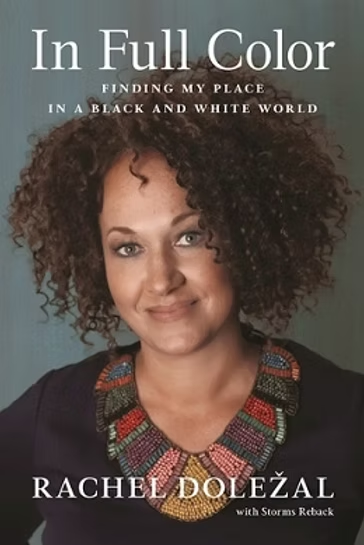
What followed from the public outcry was utterly remarkable. Readers should note that, during this time, the firestorms of the trans-sexuality and gender identity controversy were just starting to emerge into mainstream public discourse. Case in point, in April of that very same year, Bruce Jenner proclaimed himself to be a woman in a 20/20 interview with Diane Sawyer, and, in the following July, a mere one month after the Dolezal scandal broke, subsequently appeared on the cover of Vanity Fair magazine with the new name “Caitlyn.” It was within the context of this zeitgeist that Dolezal, in an attempt to mitigate the public opprobrium against her, began to proclaim herself to be “trans racial”—a position that was inexplicably sufficient to earn her a book deal from BenBella Books, the result of which was her formally published memoir entitled In Full Color: Finding My Place in a Black and White World.
There is simply not enough space in the context of this article to comprehensively disentangle the logical intricacies of this issue. That subject alone is sufficient to fill several books; therefore, I have no choice but to temporarily refrain from fastidiously layout out my position on transgenderism (though indeed, the list of things that I need to circle back to address continues to grow increasingly longer). However, I nevertheless feel compelled to briefly mention a glaring contradiction that, in my personal observation, appears to be completely absent in public discourse. Those individuals who emphatically proclaim that one’s gender is wholly subject to personal definition also maintain that one’s race/ethnicity is an nonnegotiable characteristic of birth. Case in point, Rachel Dolezal disappeared into obscurity. The trans activists never awarded martyrdom status to her, which is peculiar for two reasons.
First, maintaining that things like ethnicity/race or age are immutable characteristics makes the claim that “gender is subject to self-identification” completely arbitrary. Second, it’s worth noting that, when compared to so-called “gender identification,” it makes far more sense for one’s “cultural identification” to incongruently “bleed over” or “misalign” itself across heritage boundaries. The intricacies of this subject could also easily fill an entire tome if my objective was to articulately organize the labyrinthine web of logical propositions that would necessarily constitute a comprehensive and unassailable position on this question—a task that would undoubtedly be valuable, but, like so many other proverbial stones left unturned throughout the course of my writing thus far, greatly exceeds the humble parameters of a single blog post extemporaneously striving to encapsulate unarticulated understanding, and will need to wait for later writings for further elucidation. However, as a temporary place holder for now, I believe it sufficient to point out how easily and unquestioningly modern people accept the notion of, for example, a Swiss citizen of Chinese ancestry (let’s just call her “Angélique,” for example’s sake) who—born and raised in Lausanne (i.e. the largest metropolitan center of Switzerland’s Francophone region sharing a border with France itself)—far more relates to French cultural norms and “identity” than her Chinese ethnic heritage. For those of us who live in the West, Chinese people who are completely unable to speak their ancestral language is such a common sight that, unless explicitly indicated, we pay it zero second thought. This is so normal and unremarkable to us because we all intuitively understand how the process of assimilation works. Of course Angélique speaks French rather than Chinese. Of course she considers herself to be more “French” than “Chinese;” it is a natural and normal consequence of where she was born and raised, right? Yet, despite the universally intuitive acceptance regarding this case and others like it, the modern populace recoiled from Rachel Dolezal. The boogeyman of “cultural appropriation” is a term that, for better or worse, now exists in our common contemporary vernacular.
Okay, but how exactly are these two things fundamentally different? What exactly “went wrong” in Dolezal’s case that indelibly separates her from the “hypothetical” Angélique?
For starters, there appears to be a fundamental difference between how these two individuals “claim” their identities. Angélique never tries to convince anyone that her ethnicity is anything other than Chinese, let alone French or any other subcategory of “white,” nor does she ever try to use civic inclusion to insist that others embrace her as “French.” She’s not even a French citizen—she’s a Swiss citizen. Given these constraints, what is it exactly that Angélique can do? The answer, I believe, exists strictly at the level of culture, which is exactly what makes Angélique so authentic whenever she speaks about or—far more importantly—embodies the French cultural identity. There’s nothing inauthentic about her being completely at home living and working in places like Lyon or Marseille (i.e. the French provincial capitals sharing the border with Switzerland), and as such, the people of each of these places fully embrace her as a full standing member of their community, their “group.” On the other hand, Rachel Dolezal appears to have embodied several fundamental errors, the most egregious of which was to base her self-presentation to others on fraud. Although Angélique’s case demonstrates that ethnic heritage is not a prerequisite for one to authentically partake in a given culture, Dolezal’s case very clearly demonstrates that there’s an extremely wrong way of doing that. I mention these case studies with such punctilious detail because they represent the framework within which I attempt to essentialize the key phrase in this entire subject: “to authentically partake in any given culture.” When done properly, I believe it to be fully possible, even for an ethnic “outsider,” to accomplish this in a way that not only does honor to the culture in question, but also contributes to its continuity through time. What seems to be wholly lacking in a case like Dolezal’s is the idea of “earning.” She did not “earn” the standing to engage in the behavior that made her infamous. Indeed, that’s exactly what made her fraudulent.
Case in point, an individual like Jazmine “Saichko” Ross—a British woman not only born and raised in Japan, but who also completed 100% of her education in local Japanese schools all the way up to the graduate level—is an incontrovertibly real-life demonstration of what this “earning” process can look like in an Oriental context.
One of the things that struck me about this YouTube interview was her very justifiable unfamiliarity with the land of her inherited citizenship. Altogether, she has only ever spent a handful of months in the U.K. For all intents and purposes, Japan is really the only thing she has ever known. She, like Angélique, is wholly authentic in her embodied participation in a culture—an Oriental culture, no less—to which she personally has zero genetic connection.
But now, after all this exposition, the fundamental question that initiated this inquiry still remains—why the Orient specifically? There is something deeper at play here than simple generalized xenophilia. Indeed, I have traveled the world more extensively than most U.S. Citizens, which—given that most Americans do not even own a passport—might very well be a low bar; and the general narrowness of the American mind characterized by pervasive ignorance, if not outright indifference to anything that occurs beyond our borders, is wholly repugnant to me. However, at different points in my life, I have observed various individuals who embodied an unarticulated connection to antiquity that is wholly lacking in American society, and these individuals have largely been of East Asian descent. I by no means seek to insinuate that the cultural groups native to places like Egypt, Persia, or the Hindustan peninsula do not possess civilizations as equally ancient and rich as what one may find in the Sinosphere. However, if I allow myself to fall back on Robert Pirsig’s terminology, there exists a unique Quality in the Orient that is extremely difficult for me to describe let alone explain, not least of which is due to the fact that I myself am still just a novice in this field. However, that Quality serves as the power that continually draws me to the Orient, though my citations, for now, are still somewhat rudimentary.
To wit, I remember the first time I ever saw Portrait of a Beauty (美人图)—a 2008 South Korean film that presents a fictional biographic retelling of Sin Yun-bok (申润福), who was a real-life painter from that country’s Joseon Dynasty period (i.e. 1392-1897 A.D.) and widely lauded as one of the greatest Korean artists to have ever lived. In this dramatic retelling, the “actual” Sin Yun-bok died in childhood due to parental-pressure induced suicide, and the “Sin Yun-bok” who went on to achieve historical significance was in fact his younger sister who, at the behest of their father, used cross-dressing to assume her dead brother’s identity as a way to enter the Korean Royal Academy of Painting (i.e. “图画署;” pronounced “Do-hwa-seo”) and avoid that institution’s admissions ban levied against women.
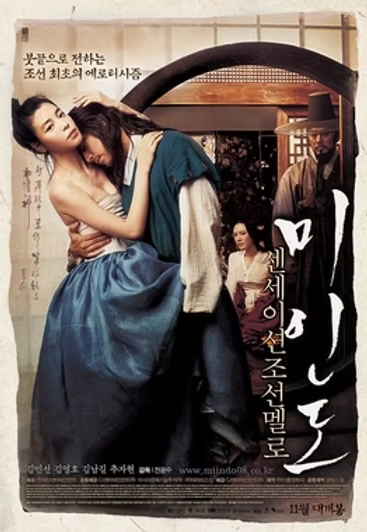
After several years of hiding her true identity, however, this state of affairs grows increasingly unsustainable. She eventually falls in love with a roguish street brawler who inadvertently discovers her true gender and ultimately returns her affections. Their budding romance reaches a high point in the middle of the movie where, protected in the privacy of a rarely visited storage chalet, with red tapestries hanging from the ceiling while flowing in the wind, she is finally able to shed the male garments that have for years constrained her daily life and reveal her womanly figure to the man who captured her ardor. She disrobes and climbs on top of him, and lets her long hair down (it was in a male bun on top of her head). The curvature of her back is perfect. She begins to rock her hips back and forth on top of him, and starts sensually moaning. He too had long hair, and when he rolled on top to mount her, one could see it draping down his back.
I found this sex scene to be so visually stunning. There was something that gripped me about Sin Yun-bok’s sensuality, her long hair falling down her back, allowing her lover to see her in her fullest, in her most feminine. But also, there was something powerful about her position of being on top—the proverbial “star of the show.” As a metaphorical “object of worship,” it was her pleasure that mattered. The man, by contrast, was a kind of “vessel,” but even more crucially, he had earned this scene. He had earned seeing her in her ultimate naked beauty. He was strong, a fighter, but significantly, he also possessed a sensitivity to him—a sensitivity nearly unheard of in Western men. He was not fighting nature, even though he could. He was working with nature, like someone forming pottery, going with the motion of the clay, slowly shaping it into something of worth, moving it from formless chaos into useful order. He was looking at her beauty and seeing what could be.
Initially, it might seem to be a very odd juxtaposition, but I compare and contrast this scene with another from the first season of Netflix’s Marco Polo, where the Taoist warrior monk named Hundred Eyes (百眼), while teaching the newly arrived Venetian traveler the rudimentary fundamentals of martial arts, has the following to say about the meaning of the word Kung Fu (功夫)—a word whose meaning that we also mostly just take for granted in English:
If you one day make it back to the West, what will you tell men of this strange word—kung fu? Will you tell them that it means to fight? Or will you say, like a monk from Shaolin (少林), to summon the spirit of the crane and the tiger? Kung fu—it means supreme skill from hard work. A great poet has reached kung fu. The painter, the calligrapher—they can be said to have kung fu. Even the cook, the one who sweeps steps, or a masterful servant can have kung fu. Practice, preparation, endless repetition, until your mind is weary, and your bones ache, until you're too tired to sweat, too wasted to breathe—that is the way, the only way, one acquires kung fu...
I find this commentary on a single Chinese noun to be so profound. For one thing, he says it outright—Sin Yun-bok, by virtue of her painting, embodies kung fu. Even in the sex scene between her and her beloved, she uses her brush to paint a bamboo landscape on his back as a form of postplay after extensive sexual climax, and then sensually presses herself against him so that the picture also gets imprinted on her chest.
For Western audiences, Hundred Eyes is a semi-familiar sight, because we see truncated echoes of the warrior sage archetype in our own narrative characters like Obi Wan-Kenobi from the original Star Wars trilogy or even Master Splinter from Teenage Mutant Ninja Turtles. It’s more intuitive for us to associate “one who has attained kung fu” with the masculine, and Hundred Eyes gives us a much clearer picture of this masculine manifestation of kung fu because age has yet to wither his virility.
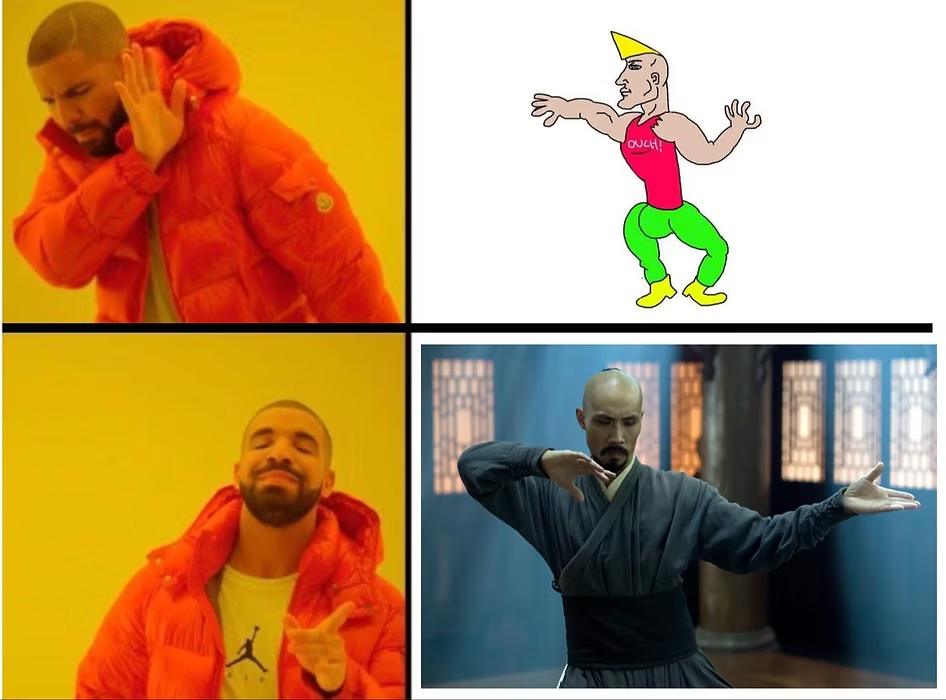
What we see, then, when comparing Sun Yun-bok and Hundred Eyes, is a kind of polarity—a polarity in which true “kung fu” equally, though very differently, manifests between masculine and feminine forms. But what happens if we extract this idea one step further? What is the fundamental commonality between Sun Yun-bok and Hundred Eyes with regards to their kung fu? It is an embodied supreme attention and pursuit of excellence. This is exactly what Robert Pirsig was talking about in Zen and the Art of Motorcycle Maintenance when he used the allegory of the mindful craftsman (in contrast with the insouciant technician) to describe the idea of Quality. Imagine that...an entire civilizational ideal predicated, as the most fundamental idea of heritage, not on justice (*ahem* Plato), or happiness (*ahem* Aristotle), or even God (*ahem* Moses), but on excellent Quality. This, right here, is always what drew me to Oriental culture, and indeed, is fundamentally the reason why I decided to join Erotica Sinica—I’m here, in large part, to pursue and attain my own “kung fu,” and I have good reason to believe this is the best way to achieve that objective.
But there are even more layers at play, here—layers that arise from Sun Yun-bok’s presentation of feminine kung fu, particularly regarding sexuality and sensual eroticism. In other words, her kung fu is exactly what expands and enhances her salaciousness; that’s what made her sex scene so hypnotically captivating—the medium of her kung fu oscillated between her brush and her body. Her femininity is both bound to and made more powerful by her kung fu in the same exact way that Hundred Eyes’ masculinity is to his kung fu. Permitting myself to use more colloquial slang from our current era, this connection to excellent Quality via one’s “kung fu,” which makes Hundred Eyes such a “Chad,” is exactly what makes Sun Yun-bok such a goddess, particularly in that sex scene. Now, compare this with the state of affairs of what we have here in the West, and the stark contrast is nothing short of appalling...
Femininity in the West is certainly lost, especially when one examines who our current icons are. One need look no further than Taylor Swift as a huge example of an ugly and poor interpretation of femininity—an interpretation that is whiny, childish, and lacks both taste and class. It is no surprise that I myself looked at femininity as a young girl and thought that I did not want any part of it. However, there were some icons who I looked at with a certain degree of curiosity, and certainly played with quite a bit, in terms of trying to latch onto some archetype that resonated with me on some level. These icons were Shakira, Britney Spears, and Christina Aguilera; however, these women seemed to base their careers on the power of their sexuality alone (which, upon further reflection, strikes me as extremely odd, because each one of these women are ostensibly musicians, and yet the excellence of their “music” frequently came across, at most, as an ancillary consideration to their embodied sexual ardor, which itself is not necessarily a problem, but ultimately seems to suggest that something went amiss in the admixture between these two elements).
Taylor Swift, by contrast, does not do this, at least not explicitly. Her thin, dainty figure and her gaudy, shapeless, cowgirl-chic clothing do not exactly scream sexy, but they do appeal to the masses. Consequently, she is insanely popular and rich, but these conspicuous characteristics are by no means to her credit. She is tapping into a grotesque, stagnated version of femininity that is trapped in girlhood. Case in point, the following is what Dr. Camille Paglia had to say during an April 25, 2016 conversation with Tyler Cowen at George Mason University’s Founders Hall:
She (Elizabeth Taylor) represented to me everything — the pure sexuality that had been repressed during the Doris Day 1950s and early ’60s...There were so many phenomenal images that I was inundated with when I was in high school and college, and what do these kids have today? Taylor Swift? Oh, my God. She is such a fake. She poses in things that she imagines are sexy and sultry, and it’s so fake. Awful, awful, awful.
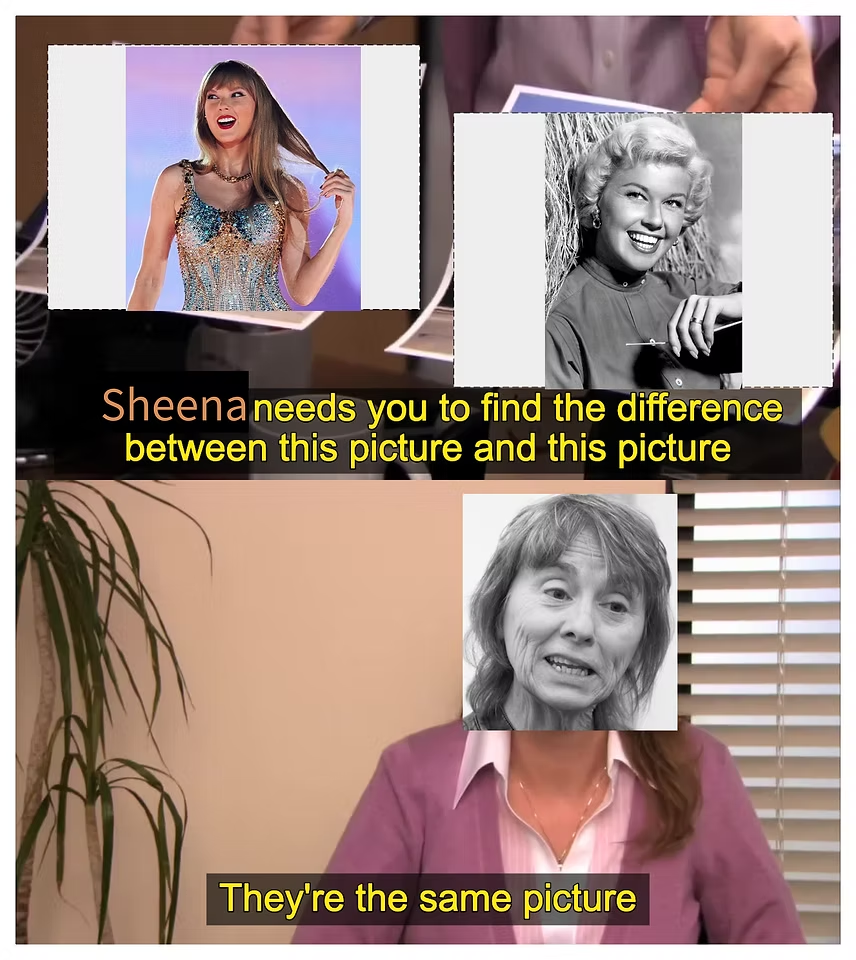
This is what people like Dylan Mulvaney are mimicking and what makes watching his videos so disturbing. He does not even hide the fact that he is trying to tap into some weird stagnated version of femininity, saying things like “day 5 of girlhood,” and publicly exhibiting a bizarre fixation on feminine hygiene products that reminded me of the fixation that young girls would have on these products. But crucially, young girls become fixated on these products because they are learning how to use them, and Dylan had a fixation on these products because he is trying to tap into a girl archetype rather than a woman archetype—let alone a woman with any form of “kung fu.”
The very idea of “femininity” is so lost in our society that its meaning or significance remains wholly unclear to anyone. Just look at the legions of pseudo-transexuals trying to present themselves as female by wearing a dress, donning make-up, and skipping around. So-called “bimbofication”—another example of femininity gone wild—induces men and women alike to conflate femininity with girliness, it’s principal proposition being that the “girl” needs to be saved because she is too stupid to do anything for herself. It is a purposeful and warped presentation of a woman whose primary character trait is the generation of illegitimate reasons to be “saved.” There exists massive confusion in the current zeitgeist as to what the female archetype ought to be. The archetypal woman is not supposed to put herself in danger on purpose. Danger already exists and requires no human assistance to propagate. It is a huge insult to men to pursue this “bimbofication” idea, because it underestimates man’s ability to authentically protect women. It is fundamentally a kind of bait-and-switch—a “slight-of-hand” that entices men with the allure of a sexually concupiscent woman to then swap out his prize for a woman who actively creates obstacles. Men do not need women to put themselves in compromising positions on purpose.
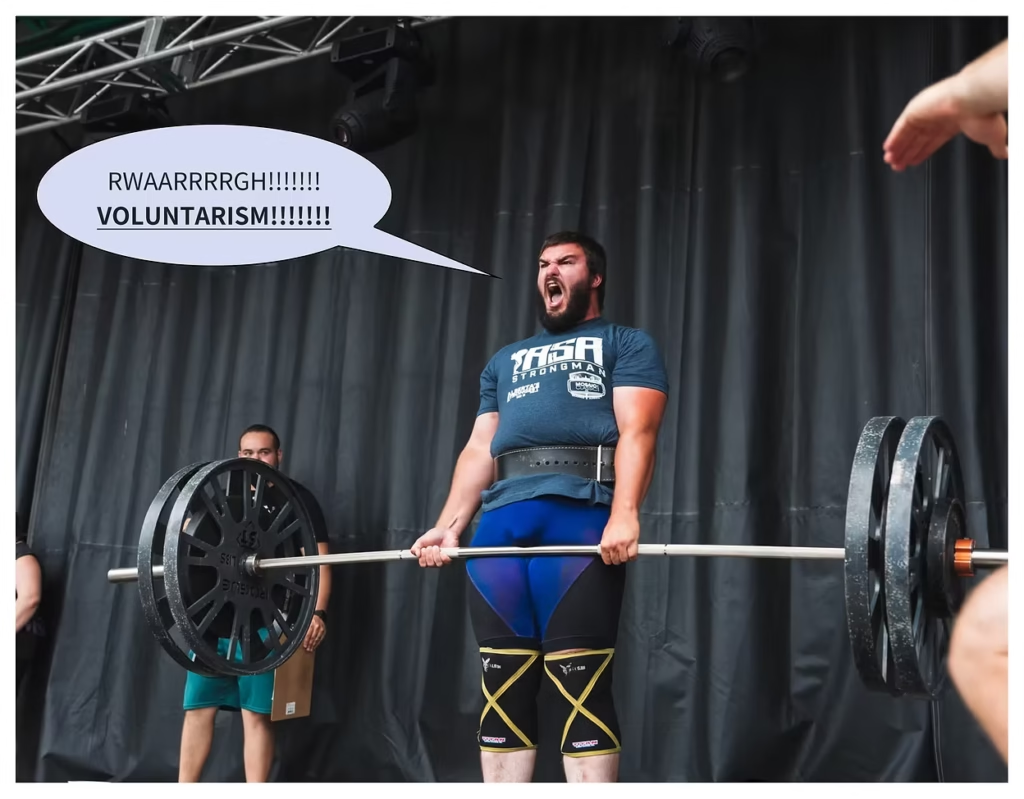
In my previous article, I used the phrase “the most fundamental idea of heritage“ when describing excellence—or Quality—as a civilizational ideal. Specifically, my usage of the word “heritage” might strike some people as peculiar given the context in which I deployed it, but I believe this confusion arises from woefully imprecise considerations of cultural identity that Westerners typically harbor. For those of us born and raised in the New World, there exists a propensity to hyper-focus on decision principles at the level of the individual. Throughout my life, I’ve watched all subcategories of white people shirk away from placing any importance on lineage-specific considerations, as if it were anathema. Case in point, I once heard, many years ago, while on my lunch break, an American coworker of mine say outright, “there is no such thing as ‘cultural values;’ it’s merely an ineffective way to describe individual behavior.” The very idea of “culture,” for us, is nothing more than the network of propositions that multiple individuals agree upon to facilitate voluntary association. The only “cultural values” that ever matter are the ones that can universally apply to everyone. We fall to our knees in rapturous worship at the altar of Voluntarism, with the “generic individual” serving as our sacred and holy messiah. I have listened to American Christians unabashedly declare, “it doesn’t matter what our lineage is, because everybody just comes from Adam and Eve anyways.” This expunging of any sort of unique past that is not immediately sharable to all has a relatively extensive history in the United States.
To wit, we take the allegory of the so-called “melting pot” for granted, but there are few Americans who remember that The Melting Pot was actually the name of a 1908 stage production that follows the story of an idealistic composer named David Quixano, who—after escaping the pogroms of Eastern Europe to the U.S.—writes a symphony called The Crucible to express his desire for all ethnic distinctions to eventually disappear. The story climaxes at the end in a triumphant monologue in which our intrepid protagonist euphorically proclaims:
There she lies, the great Melting Pot—listen! Can’t you hear the roaring and the bubbling? There gapes her mouth—the harbor where a thousand mammoth feeders come from the ends of the world to pour in their human freight. Ah, what a stirring and a seething! Celt and Latin, Slav and Teuton, Greek and Syrian, black and yellow, Jew and Gentile, East and West, and North and South, the palm and the pine, the pole and the equator, the crescent and the cross—how the great Alchemist melts and fuses them with his purging flame! Here shall they all unite to build the Republic of Man and the Kingdom of God...what is the glory of Rome and Jerusalem where all nations and races come to worship and look back, compared with the glory of America, where all races and nations come to labor and look forward!
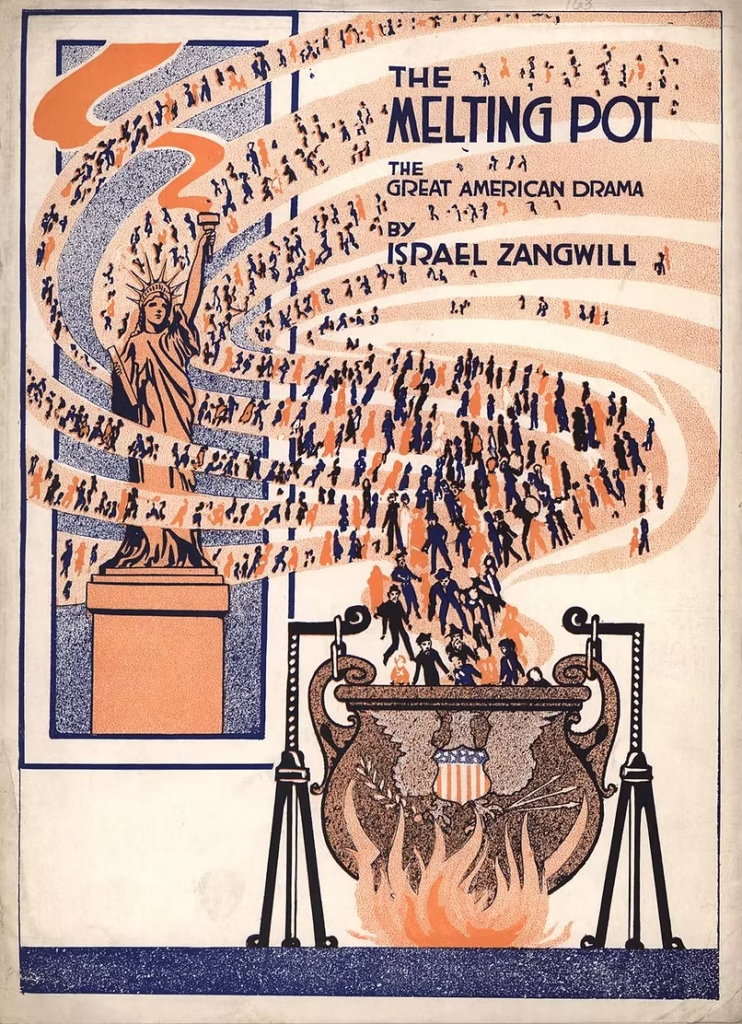
On its face, this kind of wholesale purging of the past strikes me as fundamentally divorced from the excellence of Being that Robert Pirsig was describing with the word Quality. What's more, Americans often enshrine this idea with a kind of "individualism" that manically and proactively proclaims that "the details of individual lineage are only ever fodder for villainous persons who seek to weaponize these details to pass judgement upon others and proclaim that there are obstacles where none exist." In fact, this is exactly the presumption upon which we've founded our national ethos here in the United States—"discard all that came before to achieve the future with no baggage weighing you down!" These blanket appeals to "the future" or "progress" as justification for this melting pot dogma reminds me of Pirsig's commentary about the insulting square of grass affixed to a hideous architectural structure as a vulgar reminder of the natural beauty that was destroyed to make way for a visual monstrosity. It was not until I began to immerse myself in studying the Orient that a realization dawned on me to which nobody appears to give any second thought. Why is it that white people in North America, regardless of where in Europe their families originated from, have absolutely zero sense of diaspora? This word, without fail, means absolutely nothing to us (the one exception I would make to this claim would be the Jews, but that would require asserting that Jewish people are white, and that's dangerously close to the Whoopie Goldberg territory of "Nazism had nothing to do with race;" and there is definitely not enough space in this article to address that particular can of worms). I have heard stories of Baby Boomers unabashedly proclaim—completely serious and with zero trace of satire—"my heritage is American!!" Any conversation about group identity, should white people even deign to broach the subject, invariably turns to the Constitution, the Declaration of Independence, or any other of the myriad accoutrements that constitute our national mythology. I cannot help but think of steroid junkies—collectively "juicing" and then barking together like inflated dogs at the squat-rack or the bench press—when I watch Americans of European ancestry fixate on the universalizability of individuality über alles, and it grows increasingly apparent to me as time goes by that this type of shallowness comes at an enormous cost.
On this point, I offer myself as a very representative example of this issue. My own family originates from Corpach—a tiny village next to modern-day Fort William on the coast of an extremely narrow gulf that reaches deep into the Scottish Highlands. Both my patrilinial and matrilinial lines settled in the adjacent islets along the coast, with certain branches of my family even making it as far as contemporary Northern Ireland, which means that, in terms of blood heritage, I’m 100% Scots. I personally had to expend significant effort to procure these details, but here’s the kicker: I have no idea what it means to be a Scottish woman.
This here is at the crux of the loss to shallowness that I mentioned earlier. Our heritage, if it is to be more than lifeless trivia with which we entertain ourselves on a 23-and-me test, ought to inform us of what roles we are behooved to embody and, perhaps most critically, how to accomplish that objective. This, I believe, is what the Oriental example demonstrates so powerfully. We in the West do not expect each subsequent generation to reestablish scientific principles for themselves—things like the dangers of mismanaged bacteria or the benefits of properly harnessed mechanical power—so what possesses white Americans to do exactly that when it comes to the principles of cultural identity and heritage? This corpus of multi-generational wisdom is supposed to be the essence of legacy (but again, we seem to have no understanding of that word’s meaning either)—wisdom that leapfrogs through time connecting the distant past to the distant future.
However, in lieu of this, what is one supposed to do? Given the pervasiveness of pop culture in the United States, one common answer seems to be the valorization of popstars, but the pathology of this course of action appears to share characteristics with the problems that arise when people rashly attempt to expunge religion with secular atheism. But what does this mean, exactly? If the embodiment of deep tradition does not occupy an extremely high position on one’s priority list, what happens is that false idols (i.e. “celebrities”) then begin to hijack, in piecemeal, archetypal elements in order to manufacture something that, while lucrative in the short-term, no longer holds the meaningful depth of the original tradition in question. The priority becomes “that which is novel”—a priority that is the very cornerstone of “pop culture” not only as a social phenomenon, but also as a concept in and of itself. This expunging of tradition in favor of pop culture is a catastrophic mistake, and is probably part of the reason why Americans face such a starvation of depth in meaning in their own lives—we have allowed novelty and celebrity to supersede tradition and culture.
It is a relatively common idea these days to compare “traditional” women and “trad wives” with modern women. Usually, when they refer to traditional women, they refer to women who are domesticated—those who stay in the house, the housewives. However, as far as I can tell, the “housewife” is a very new invention. The Scots from whom I descend were families of farmers and yeomen, where the women milk cows, feed pigs, shovel hay, etc. They spent most of the day outside, and then butchered a chicken to make a meal for the family. They lived lives defined by unending labor that would often corrode into toil. Their hands were calloused and their legs were bruised. They wore pants—or overalls—and boots to help their husbands tend the farm. This is the image of what life looked like for the majority of Scottish women that I’ve been able to piece together, and from this image, I surmise that if my ancestors were to explain to me what it meant to be a Scottish woman, their descriptions would resemble nothing of Taylor Swift. As far as I can tell, the Scots have lost much of their connection to their own culture, as is demonstrated by the language having dwindled down since the middle ages, since Paganism was overtaken by Catholicism, since English was the only language allowed to be spoken or taught in the schools, since Protestantism made its way into the southern United States. So, if even the Scottish clans who have managed to remain in the Highlands this long have lost touch with much of their language and culture, what does that mean for the Scots who reside abroad? We are lost.
My family has been in the States since the mid-1700s—the result, in part, of being on the wrong side of the Jacobite Rebellion—and so the distance of time and space between myself and my Scottish ancestors is huge, and without that connection to what it means to be Scottish, I have great difficulty latching onto any other sort of identity.
It seems to me as if one’s genetic line, one’s family, one’s culture, one’s traditions are supposed to be central to one’s identity and that other categories stem from the foundation of that central characteristic—a sort of pillar that allows one to build upon it, and I seem to have lost any idea of what that is supposed to be for the simple reason that people are not optimized to figure out 100% of our own decision principles to navigate the environment we inhabit. We are designed for continuity.
And yet, Americans appear to take a peculiar pride in the inability to distinguish between informing us of the roles we ought to pursue and embody, versus dictating those roles to us. We are so seduced by the slogan that brazenly proclaims “just define your own rules for yourself!” However, this usually leads to an utter disregard for our evolutionary limitations as people, and in a heedless fight between Man and Nature, Nature will always win. So, given the totality of these circumstances, what could I possibly do to begin rectifying these compounded problems? My attempt to answer this question sits at the core of the meandering journey by which I found my way to the doorstep of Erotica Sinica. The conclusion that I have come to as a result of my time with Erotica Sinica unequivocally strikes people as absurd prima facie; however, my belief is that learning about Oriental culture can help me to be more Gaelic. Now, how on earth could that possibly be the case? To understand the answer to this question, like in Pirsig’s chautauqua, we must come at it obliquely.
My previous commentary about Portrait of a Beauty and why that movie captivated me so strongly is indicative of something that I have wrestled with since the time I was very young. Whenever I looked at the archetypal Oriental woman, I could see a connection to culture that grounds her in something of extreme depth—the ancient traditions that connect her to a deep continuity. I looked at this with great admiration, and I found many of these women to possess a grace that is unprecedented in American society. Whenever I would see this in action—this firm grounding in the legacy of one’s heritage made manifest in the allure of the individual—the beauty not only completely transfixed me, but also crucially, it sexually aroused me. This mystic combination of admiration and arousal would then coalesce into an unarticulated worship and yearning.
I am no stranger to pornography and the salivating lechery that can bring, but watching Sin Yun-Bok mount her lover and rock her hips back and forth, her long hair down her back, in full command of her body, instigated a type of sexual arousal that was almost madness inducing. Not only did she have this great masculine power to her, she simultaneously possessed a great ability to also concede, to allow the man to take over, to feel the pleasure in his overcoming and taking of her, to welcome and invite that masculine strength in, both metaphorically and literally. It was a power in submission, a voluntary action of giving up control—a power to say that she was allowing the man to take over because he has earned it, and because she was trusting herself in him. This power derived from deep feminine submission enables herself to experience great pleasure, and to allow him to facilitate this great pleasure. It is extreme trust and vulnerability, to allow him to lead, to give him that control that he cannot have without her.
These considerations set the intellectual and sexual tableau for the time when I eventually stumbled upon the opportunity to join Erotica Sinica. To be sure, I was incredibly excited at the prospect of becoming intimate (in all senses of the word) with Asiatic sex workers, but far more critically, I found myself incredibly eager to tap into the Quality these Oriental women possess, to discover what I might be able to find by studying their language, traditions, culture, music, folklore, etc. But in the face of such a decision, I found myself vacillating. I was beset upon by a conceptual contradiction that I was powerless to unilaterally resolve. Clearly, Erotica Sinica, as a brand, seeks to occupy and service a very specifically Asiatic-oriented niche in the adult entertainment marketplace.
How then could I explain, in a self-referentially coherent way, my association with Erotica Sinica given my own ethnic makeup? Obviously, I was not about to become a female version of Oli London, but given how absolutely absurd I found the UK’s Channel 5 casting of Jodie Turner-Smith as Anne Boleyn, I legitimately did not know whether it would appear to be the case that I was committing the same philosophically preposterous monstrosity—and thereby making myself look as if I were a textbook hypocrite—by allowing my sex work to become subsumed under the auspices of Erotica Sinica.

These were among the many concerns that I brought to the chief program director at Erotica Sinica, who, much to my assuagement, demonstrated enormous patience and appreciation for my disquiet over the course of several months worth of conference calls. To allay my concerns, he explained to me that the word “Chinese” does not refer to any one particular ethnicity. The Chinese people, rather than a homogeneous monolithic group as we here in the West often mistake them to be, are a confederation of many different ethnicities and sub-ethnicities that, despite thousands of years of interacting and intermingling, still retain culturally, linguistically, and even physically distinct characteristics even unto this very day, which is something I never would have learned from anywhere else. “One of the primary engines of Chinese civilizational power,” he explained to me on one such phone call, “is Confucian thought; and the primary hallmark of Confucian teaching is filial piety toward one’s own forebears, which is why so much of Chinese moral virtue arises from ancestor worship.”
It was at this point in our discussions that a twin set of realizations struck me like a pair of lightning bolts. First, it suddenly explained, at least in part, the origins of the Americans’ stereotypical inability to distinguish the various Asian nations, particularly at the level of culture, from each other.
While it is indeed true that the categories of “Chinese” and “Japanese” are not the same thing, there does exist a deeply rooted under-current that culturally connects the entire Orient together. Unlike Christianity, Confucianism never in its history spread itself by means of military conquest or aggressively assimilationist policies. Rather, these teachings were willingly and readily adopted by China’s neighbors, and it appears to me that the central emphasis on one’s own ancestral line and legacy contributed to Confucianism’s exportability, because, to take a random example, one is no less “Korean” simply because one adheres to the precepts of Confucian teaching. In other words, kung-fu in the sense that Hundred Eyes references—the excellence embodied in supreme skill—is supposed to be a vehicle that can connect one back to one’s lineage vis-à-vis filial piety.
Second, and perhaps most crucially, I realized that this Confucian idea of role-based excellence is the answer to the West’s incognizance with regards to what powerful femininity looks like. Western civilization has come to assume that the acquisition of kung-fu is a categorically masculine pursuit. This is why Western feminism calls for women to “lean in” and become “girl bosses” under the banner of “girl power.” In other words, when Western women pursue “supreme skill,” they become adversarial towards men, because they mistakenly believe that becoming competent automatically puts them in competition against men. But this reveals one of the greatest metaphorical points contained within the narrative structure of the sex scene from Portrait of a Beauty that I mentioned previously. Sin Yun-bok’s sex scene was not simply an instance of her getting naked; but rather, it was the sexual embodiment of her casting off of the male form that unnaturally constricted and confined every aspect of her life for so many years, and the result was sexually majestic. In light of this example, it becomes extremely clear why Western femininity is so abysmally lost. Because we assume kung-fu to be inherently masculine, we have created for ourselves a perniciously false dichotomy. If we want to be feminine women, we must be pathetically helpless (i.e completely devoid of any kind of skill, let alone supreme skill) as the only alternative to becoming subpar imitations of men ourselves. We see this exact problem play out in the context of our own pop culture narratives like Sex and the City where Miranda’s immense professional success constantly emasculates her boyfriend Steve, thereby causing endless friction in their relationship. These two dysfunctional options—the incompetent bimbo and the emasculating girl boss—completely precludes the ability to have functional female heroes in the narratives of our modern cultural mythos.
These were the considerations that eventually generated my confidence to proceed with Erotica Sinica, because, when armed with these two ideas in tandem—the Confucian focus upon one’s own lineage and the uniquely feminine kung-fu that pursuing such Quality can provide—I became assured that immersing myself in the traditions of the Far East would not collapse into the post-modernist relativism that currently plagues so much of identity politics in the West (i.e. “I am X because I feel like it”). What’s more, I realized that there does exist a way to pursue and embody this Orientally feminine kung-fu that is explicitly sexual in nature.
By now, several Western pornstars have already collaborated with Japanese porn studios. Seeing as AMWF (i.e. “Asian Male White Female”) is an established genre in Japanese porn, this is nothing new. However, the vast majority of these collaborations are extremely short lived, usually amounting to little more than a couple of videos. In most instances, the porn that results from these cursory interactions are extremely uncompelling. There’s never any preparation on the part of these women to overcome the language barrier. There’s zero interest, insofar as I can tell from the consumer perspective, in interacting with Asian audiences, and they barely have any kind of legitimate interactions with the men they copulate with on camera, and I don’t simply mean that in a linguistic sense. Almost every aspect of these women’s performances exudes boredom, even when they are face-to-face with some of the most strikingly handsome men that Japanese pornography has to offer, so it is little wonder that there is an utter lack of longevity within this space. However, there is one exception to this paradigm that caught my eye some time ago. Her name is Lily Hart, and not only is she striking from a purely physical standpoint (i.e. I personally would jump at the opportunity to have sex with her), she also appears to be completely fluent in Japanese as well.
Clearly, she has spent a significant amount of time in Japan in order to be able to perform sexually in Japanese while on camera. But what I found the most noteworthy is the fact that she exudes the coy countenance for which all the top Japanese pornstars are known—a feminine carriage that is largely absent in Western women, including those in the US adult entertainment industry. This is the sexual version of Jasmine Saichko Ross, who I mentioned in my previous article. Consequently, Lily Hart has become such an object of envy for me, because the pornography that she has produced encapsulates the image, indeed the avatar, to which I aspire. To put it bluntly, she is the sexual example of what I myself want to be.
At this point, it is no secret that I, at the time of this writing, will soon launch my own career in porn in addition to my work in the brothel. To be sure, I technically could have done this myself a long time ago, particularly with the rise of platforms like OnlyFans. However, I knew that, if I were to do porn, I wanted to take my career in the direction that is represented by girls like Lily Hart. But there was no way I could pursue that path on my own because, as hopefully my writings thus far demonstrate, there is more at stake here than simply sex alone. It is a holistic unification of feminine sexual desire with the pursuit and embodiment of Confucian excellence that is on the line here, and in that respect, I am able to be secure in my position in Erotica Sinica, for it has been under this umbrella that I have been able to study, learn, and indeed grow in a way that is fundamentally authentic both to myself and to what I’m trying to achieve and bring into the world. For while it is indeed true that I will always remain a daughter of the Highlands, it is also equally true that I have found communion with a civilization that has much to impart to me.
I look forward to sharing the intricacies of my studies in future articles, but for now, I will conclude with a sentiment that sits at the core of the excellence that I seek:
Dèan gaisge gus eòlas fhaighinn—is e sin an abairt den shoilleireachadh.
敢于求知——这是启蒙的格言
Dare to know—that is the motto of enlightenment.